
Unexpected Moving Costs: Access, Stairs, Elevators, Shuttles and Other Added Services
A practical guide to accessorial moving charges, including stairs, elevators, long carries, shuttles, parking, packing and other scope changes.

Published 4 Sep 2026 · Updated 9 Sep 2026. Sources, scope and corrections
Many moving-cost surprises begin with conditions that were visible before move day but were not included clearly in the estimate.
For interstate household-goods moves, FMCSA requires written estimates to include transportation, accessorial, and advance charges that are known when the estimate is prepared. The more accurately the move is surveyed, the fewer surprises should appear later.
What Counts as an Access or Extra-Service Issue?
Common examples include stairs, elevators, long carries, shuttle service, parking restrictions, loading docks, narrow streets, building reservations, crating, storage, packing, or other accessorial services.
Why These Conditions Matter
They can change labor, equipment, truck access, handling time, crew size, safety planning, and price. FMCSA's consumer-protection rules specifically address additional services such as elevators and long carries when preparing interstate estimates and transportation documents.
Connect the access survey to the tariff
Use this sequence: Access → Survey → Accessorial Service → Tariff → Change of Scope → final bill and delivery payment.
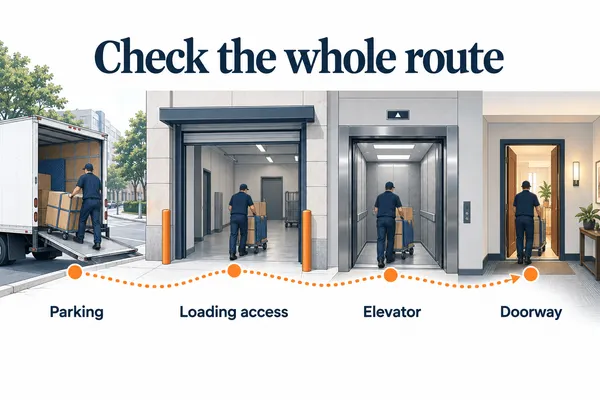
At both addresses, record the legal truck position, the full carrying route and measured distance, stair flights and turns, elevator dimensions and reservation times, and vehicle restrictions. The customer or building contact supplies access information; the estimator checks the service assumptions; dispatch and the crew need the same current record.
Ask the mover to identify the applicable tariff and effective date, service item, included allowance, charging unit, minimum and any discount. A physical condition does not automatically mean a separate fee: a service may already be included, billed through labor time, or charged under a specific tariff item. Ask how overlapping services are treated so the calculation can be checked.
Illustration only: suppose a tariff includes the first 75 feet and charges $40 for each additional 50 feet or fraction. A measured 160-foot route leaves 85 chargeable feet: two increments × $40 = $80. These are invented terms, not a standard distance or market rate. The actual tariff controls the measurement points, allowance, unit and applicability.
Check fuel, travel and coordination fees
Not every extra line is caused by stairs or difficult access. A Fuel Surcharge needs a defined calculation base. A Trip Fee or Travel Fee needs a clear route and billing-clock explanation. A Service Management Fee needs a defined coordination scope and payer. Ask whether each is included in the estimate total and whether another line already covers the same service. The label alone does not authorize an added charge.
Binding Estimates and Added Services
A binding estimate fixes the price for the described shipment and services. If additional goods or services are identified before loading and the mover proceeds, it must reaffirm the original estimate, prepare a signed new binding estimate, or agree in writing to treat the original as non-binding. For a non-binding move, it must reaffirm or prepare a signed new non-binding estimate before loading. See 375.403(a)(6)–(7) and 375.405(b)(7)–(8).
Non-Binding Estimates
With a non-binding estimate, final charges follow the applicable tariff and actual shipment and services. The 110% rule concerns collection at delivery, with specified exceptions; it is not a final-price cap. See the Moving Estimates guide for the distinction.
When an added service appears after the bill of lading
For covered interstate moves, distinguish who initiated the service and when. Under 49 CFR 375.401(f), if the mover fails to ask about and determine accessorial charges before preparing the bill of lading, it must deliver the goods and bill those additional charges after 30 days.
- The mover identifies a necessary service: 375.403(a)(8) and 375.405(b)(9) require notice before performance and at least one hour for the customer to decide. If the customer agrees to pay, the mover must obtain a signed attachment to the bill of lading; billing follows after 30 days from delivery. If the customer does not agree, the rules say the mover should perform only extra services required to complete delivery, with deferred billing, subject to the limited impracticable-operations exception.
- The customer requests an additional service: the mover must disclose the added charges. The binding-estimate rule also requires agreement to those charges and a signed new binding estimate for the added services. Qualifying customer-requested additions after the bill of lading can be collectible at delivery; they do not follow the same billing treatment as mover-identified necessary services. See 375.403(a)(9) and 375.405(b)(10).
Impracticable operations must fit the carrier tariff; do not assume every shuttle, stair or long-carry charge qualifies. Where the exception applies, its delivery collection is limited to 15% of all other charges due at delivery. That is a collection limit, not a universal fee or a cap on the final bill.
Reconcile the service record and the bill
Keep the original estimate, access notes, dated change request, required signed documents and itemized invoice together. For each addition, match the service actually performed to the tariff item, quantity, rate, allowance and minimum. Ask separately: what is the total supported charge, what is due to obtain delivery, and what must be billed later? Use the Moving Documents guide to keep the handoff consistent.
Questions to Ask Before Move Day
- Where can the moving truck legally and safely park?
- How far is the carry from the truck to the residence?
- Are there stairs or elevators?
- Does the building require an elevator reservation, certificate of insurance, or loading time window?
- Could a shuttle be required?
- What packing, crating, storage, or specialty handling is included?
- How will an unexpected change of scope be documented?
Check state rules before approving an added charge
The federal examples in this guide concern covered interstate moves. For a move within a state, first resolve jurisdiction and service scope, then consult the state requirements pilot. Ask which estimate, tariff provision or agreed service supports the charge and how a requested change must be documented. An hourly rate alone does not establish every permitted fee or the amount due at delivery.
Primary Sources
- FMCSA — How can I avoid unexpected moving costs?
- FMCSA — Summary of Household Goods Consumer Protection Requirements
- FMCSA — Estimating Charges (Subpart D)
Current regulations: Estimate and accessorial requirements · Binding estimates and added services · Non-binding estimates and added services · Tariff contents and service terms.
Explore more Moving & Relocation Help →
The Relocation Ecosystem provides educational information and does not provide legal advice. Charges and requirements depend on the move, tariff, contract, and jurisdiction.


Add your perspective
What does your experience add?
Which part of this guidance matches your experience—and which needs a different perspective?
Share one example, your role and any supporting evidence. Disagreement is welcome when it helps clarify the decision.