
Change of Scope
What a change of scope means and why added inventory, services or access conditions should update the move record.

Published 4 Sep 2026 · Updated 5 Sep 2026. Sources, scope and corrections
TRE Dictionary
Change of Scope
A change of scope occurs when the shipment, services, conditions, timing, or responsibilities differ from what was originally surveyed, estimated, or authorized.
In plain English
The move is no longer the same move that was originally planned.
Why it matters
Added items, packing, storage, access problems, specialty handling, or date changes can affect price, labor, capacity, and service commitments.
Who this affects
Customer · Sales · Operations · Crew · Billing
Where this sits in the move
Estimate → Booking → Preparation → Execution
Stakeholder perspectives
One added item or changed condition can alter labor, equipment, materials, or timing.
Responsibility and handoff
Record what changed, who requested it, the impact, and required documentation and approval before execution.
Common misunderstanding
A verbal message to one person may not reach the crew or billing team. Follow the applicable contractual and regulatory process.
TRE common-language definition
Change of Scope: A documented change to the inventory, services, conditions, timing, or responsibilities that define the move.
Related terms
Survey · Estimate · Inventory · Authorization · Accessorial Service
Put it into practice
For example, adding garage shelving after the survey may change the item count, disassembly work and loading plan. A practical change record should connect the original scope to the requested revision:
- What was added, removed or changed, and when it was identified.
- Who requested the change and who can authorize it.
- Any effect on charges, packing, equipment, staffing or timing.
- The applicable written agreement and the current inventory or instructions.
- Confirmation that operations, the crew and billing received the revision.
A request is not the same as approval. A changed operating plan also does not, on its own, establish a right to charge more.
Connect an access change to the charge record
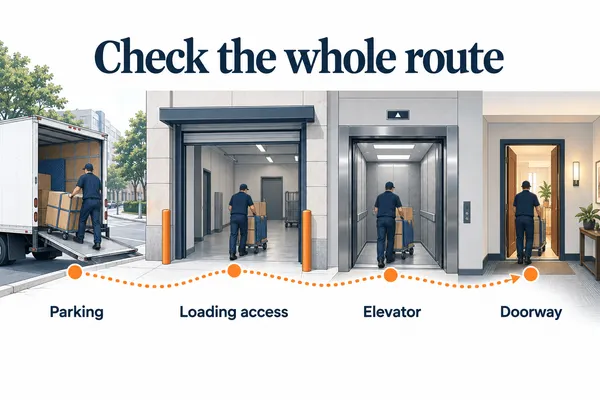
If a reserved elevator is unavailable, record the original assumption, the changed condition, the proposed stair route or other service, who identified or requested it, and when. Match any proposed price to the tariff item, allowance, quantity, rate and minimum. Send the resulting record to the customer, dispatch, crew and billing.
For covered interstate moves, the timing and initiator affect the procedure: preloading additions, mover-identified necessary services after the bill of lading, and customer-requested services after that document are treated separately in 49 CFR 375.403(a)(6)–(9) and 49 CFR 375.405(b)(7)–(10). A signed change record does not by itself make every charge payable at delivery. The Unexpected Moving Costs guide explains notice, decision time, attachments and deferred billing. Keep these records with the Moving Documents path.
Sources & Evidence
Primary consumer guidance: FMCSA — Estimating Charges explains how additional goods or services can affect estimates for U.S. interstate household-goods moves, including the procedures that apply before loading. The correct treatment depends on the estimate type, the timing and the circumstances; “change of scope” is not a substitute for those requirements.
TRE operating practice: The definition and change-record checklist here describe an operational framework. Other move types may follow different rules and contracts. See Sources & Evidence.
Unexpected Moving Costs: Access and Added Services · I’m Moving
Explore the full Relocation Dictionary →
September 4, 2026: Added practical stakeholder, move-stage, and handoff context to the existing definition.
September 4, 2026: Added a change-record checklist, direct FMCSA guidance and related links.


Add your perspective
What does your experience add?
Which part of this guidance matches your experience—and which needs a different perspective?
Share one example, your role and any supporting evidence. Disagreement is welcome when it helps clarify the decision.