
Why the Ecosystem Exists
About The Relocation Ecosystem
Practical moving guides, The Relocation Dictionary, and industry research to help people and professionals make better relocation decisions.
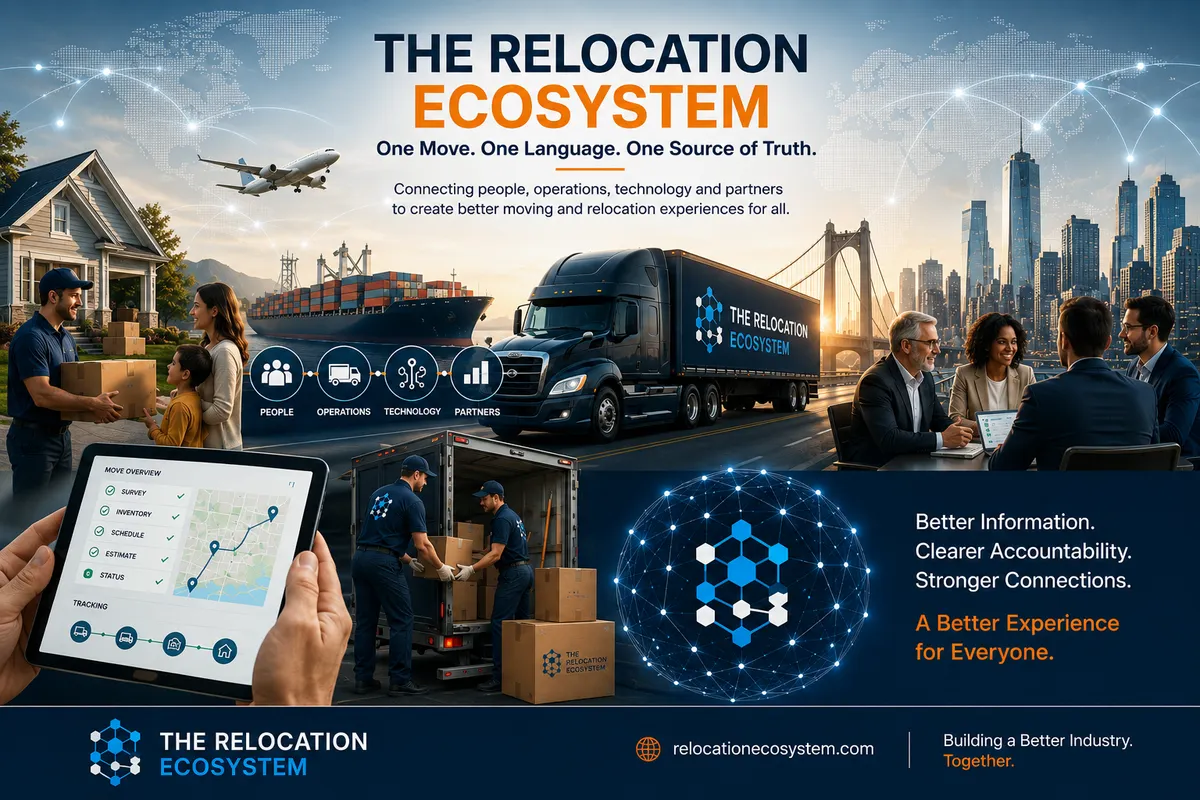
The Relocation Ecosystem is an independent publication and knowledge base. We publish practical moving guides, The Relocation Dictionary, and industry research to help people and professionals make better relocation decisions.
One Move. One Language. One Source of Truth.
Moving and relocation involve many companies, technologies, decisions, and people—but the customer experiences one move. The Relocation Ecosystem exists to help those parts understand one another better.
Today, TRE operates as an independent publication, knowledge base, and industry conversation. It is also the foundation for something larger: practical relocation intelligence, research, assistance, and tools built around clearer information rather than another isolated system.
Why The Relocation Ecosystem Exists
Relocation still operates through a patchwork of companies, processes, technologies, terminology, and expectations. Each part can work reasonably well on its own while the handoffs between them remain inconsistent.
A customer describes a move. A survey turns that description into inventory. Sales turns it into an estimate. Operations turns it into labor, equipment, capacity, and scheduling. A carrier, driver, or crew eventually has to turn all of that into the actual move.
When those versions stop matching, the consequences appear downstream as scope changes, missed expectations, avoidable claims, margin pressure, service failures, and confusion about accountability.
TRE asks where the ecosystem would work better if the information, definitions, and decisions traveled with the move.
What We Are Building
The publication is the first operating layer—not the end state.
Publication → Common Language → Knowledge Base → Practical Help → Research → Relocation Intelligence.
The Relocation Dictionary is the first structured knowledge asset in that progression, with a growing collection of public terms. The Moving & Relocation Help hub translates that knowledge into practical guidance, while TRE Research begins turning recurring questions and evidence into reusable industry knowledge.
Those future capabilities are being developed progressively. TRE does not present planned tools as capabilities that exist today.
Independent by Design
The Relocation Ecosystem is not the marketing arm of a mover, RMC, technology platform, or service provider. Its value depends on being able to examine ideas across the industry without requiring one commercial answer.
Commercial relationships, when relevant, should be disclosed. Partnership does not purchase favorable coverage, endorsement, or editorial conclusions.
Who This Is For
TRE is for anyone with a meaningful role in improving relocation: customers, moving-company owners and operators, drivers and crew leaders, sales and estimating professionals, RMCs, van lines, independent carriers, technology providers, suppliers, claims and compliance professionals, mobility teams, logistics providers, researchers, and people bringing useful ideas from adjacent industries.
About the Founder
The Relocation Ecosystem was founded by Scott Hampton, a moving and relocation professional with more than 35 years of experience across estimating and sales, operations, customer service and claims, safety and compliance, interstate transportation, business development, account management, and technology consulting.
That range of experience has provided a front-row view of the industry's evolution—from handwritten inventories and carbon-copy paperwork to digital estimating, connected platforms, remote surveys, and rapidly developing artificial-intelligence tools.
TRE grew from a simple belief: the greatest opportunity ahead may not come from one company or one technology, but from creating better connections between the people, information, systems, and businesses already responsible for making relocation work.
Join the Work
Start Here, get practical moving help, read the Dictionary, explore TRE Research, review the Sources & Evidence standards, contribute a perspective, or join The Relocation Ecosystem.
The goal is not agreement on every issue. It is better information, clearer language, stronger accountability, and better moves.
Follow The Relocation Ecosystem on LinkedIn for publication updates, or connect with founder Scott Hampton for his professional perspectives.
Follow The Relocation Ecosystem on Facebook for new moving guides, clear definitions, and conversations about the people, operations, customer experience, and technology behind relocation. Bring your moving questions and the industry terms you would like us to tackle next.
Add your perspective