
Long Carry
What a long carry is in moving and why distance between the truck and residence affects labor and service planning.

Published 4 Sep 2026 · Updated 5 Sep 2026. Sources, scope and corrections
TRE Dictionary
Long Carry
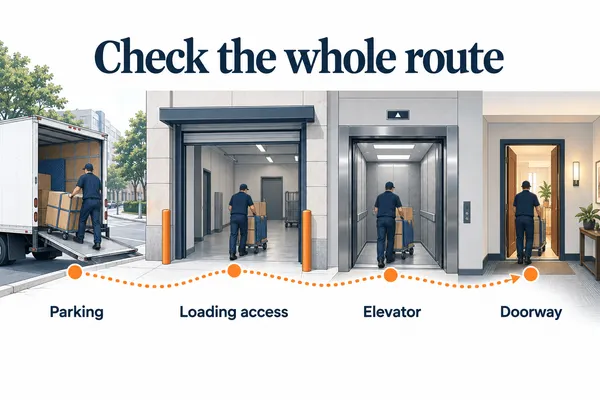
A long carry occurs when movers must carry goods an extended distance between the truck and the residence, building, elevator, or loading area.
In plain English
The farther the crew has to walk each item, the more time and labor the move can require.
Why it matters
Long carries affect productivity, fatigue, equipment use, scheduling, and—in some pricing systems—additional charges. For covered interstate moves, FMCSA requires known additional-service charges to be reflected in the written estimate when they are known at the time of estimating.
Who this affects
Customer · Estimator · Driver · Crew
Where this sits in the move
Survey → Estimate → Pickup and delivery
Stakeholder perspectives
Customers need the distance and price basis explained; crews need a practical carrying route.
Responsibility and handoff
Document the loading position, route, measurement basis, and applicable service terms.
Common misunderstanding
There is no universal distance threshold implied here. Check the tariff or agreement rather than assuming every carry is included.
TRE common-language definition
Long Carry: An extended carrying distance between the moving vehicle and the point where goods are picked up or delivered.
Related terms
Access · Shuttle · Elevator · Stairs · Accessorial Service
Check the measurement and charging unit
Record the actual carrying route and the tariff’s start and end points at origin and destination. Ask what distance is included, whether additional distance is charged in increments or fractions, and whether the calculation also uses shipment weight or a minimum. Do not substitute a straight-line map distance for the applicable route measurement.
The estimator should share the assumed truck position and distance with dispatch. If parking changes, record the revised route, why it changed and any proposed charge before the work, following the applicable change procedure.
These are practical checks, not universal fees. For covered interstate moves, see 49 CFR 375.401(f) and tariff service-term requirements. Check the Tariff entry and Unexpected Moving Costs guide for calculations, required notices and delivery-payment distinctions. Record later changes through Change of Scope.
Sources & Evidence
Read the Unexpected Moving Costs guide →
The Relocation Ecosystem provides educational information and does not provide legal advice.
Explore the full Relocation Dictionary →
September 4, 2026: Added practical stakeholder, move-stage, and handoff context to the existing definition.


Add your perspective
What does your experience add?
Which part of this guidance matches your experience—and which needs a different perspective?
Share one example, your role and any supporting evidence. Disagreement is welcome when it helps clarify the decision.