
Shuttle
What shuttle service means in moving and when a smaller vehicle is needed between the residence and linehaul truck.

Published 4 Sep 2026 · Updated 10 Sep 2026. Sources, scope and corrections
TRE Dictionary
Shuttle
A shuttle is the use of a smaller vehicle to transfer goods between a residence or facility and the primary moving truck when the larger truck cannot safely or practically reach the location.
In plain English
The crew moves the shipment in stages because the main truck cannot get close enough.
Why it matters
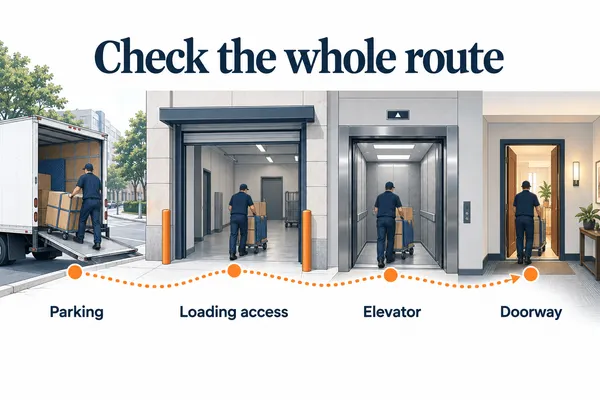
A shuttle adds handling, labor, vehicle time, and risk, and can materially affect cost and schedule. The need for a shuttle is often driven by access conditions such as narrow roads, weight limits, parking restrictions, low clearances, or building constraints and should be identified during the survey when practical.
Who this affects
Customer · Estimator · Dispatch · Driver · Crew
Where this sits in the move
Access assessment → Planning → Transfer → Delivery
Stakeholder perspectives
The customer sees an extra vehicle; dispatch must coordinate another transfer of the shipment.
Responsibility and handoff
Confirm the transfer point, vehicle, provider, price basis, schedule, and inventory control.
Common misunderstanding
A shuttle is not automatically included in linehaul or ordinary delivery. Additional handling and scheduling need clarification.
TRE common-language definition
Shuttle: A secondary vehicle transfer used when the primary moving vehicle cannot directly access the pickup or delivery location.
Related terms
Access · Long Carry · Linehaul · Destination Service · Accessorial Service
Confirm the need, transfer and price basis
Record why the main truck cannot use the service location, such as a verified road restriction or clearance limit. Confirm the smaller vehicle, transfer point, responsible provider and schedule. Keep the inventory and condition record consistent across the extra handling.
Ask which tariff item applies at origin or destination, how weight, trips, distance or time affect the calculation, and whether a minimum applies. Identify what the shuttle price includes and whether another handling or carry service is separately chargeable under the terms. A shuttle is not automatically an “impracticable operation”; that classification must fit the carrier tariff and the applicable collection rules.
These are practical checks, not universal fees. For covered interstate moves, see 49 CFR 375.401(f) and tariff service-term requirements. Check the Tariff entry and Unexpected Moving Costs guide for calculations, required notices and delivery-payment distinctions. Record later changes through Change of Scope.
Sources & Evidence
Operating-practice note: The exact meaning and charging method for shuttle service can vary by mover, tariff, geography, and equipment. TRE uses the term here as the secondary-vehicle transfer required because the primary vehicle cannot directly access the service location.
Read the Unexpected Moving Costs guide →
The Relocation Ecosystem provides educational information and does not provide legal advice.
Explore the full Relocation Dictionary →
September 4, 2026: Added practical stakeholder, move-stage, and handoff context to the existing definition.


Add your perspective
What does your experience add?
Which part of this guidance matches your experience—and which needs a different perspective?
Share one example, your role and any supporting evidence. Disagreement is welcome when it helps clarify the decision.