
Lump Sum Move
An employer-funded move using a set relocation payment: what it covers, who arranges services, and how it differs from a binding moving estimate.

Published 11 Sep 2026 · Updated 11 Sep 2026. Sources, scope and corrections
TRE Dictionary
A lump sum move is an employee relocation funded partly or wholly through a set cash payment from the employer. The employee uses that funding to arrange the covered parts of the relocation. The payment can replace some benefits or most of the relocation package, depending on the written policy.
In plain English
Your employer gives you a relocation budget. That amount does not establish the mover's price, guarantee that every expense is covered, or identify who will organize each service. Ask whether household-goods transport is inside the payment or provided separately.
Who this affects and when
Employee and household · Employer mobility team · Payroll · RMC · Mover. Clarify the arrangement before accepting benefits, booking services or paying deposits.
Managed lump sum
A managed lump sum adds a defined level of assistance, such as planning tools, counseling or access to suppliers. The label alone does not tell you whether someone books services, pays invoices or resolves problems. Ask for the actual support scope and responsible contact. A managed budget or cap may instead authorize spending up to a limit without paying the whole amount to the employee.
Responsibility and handoff
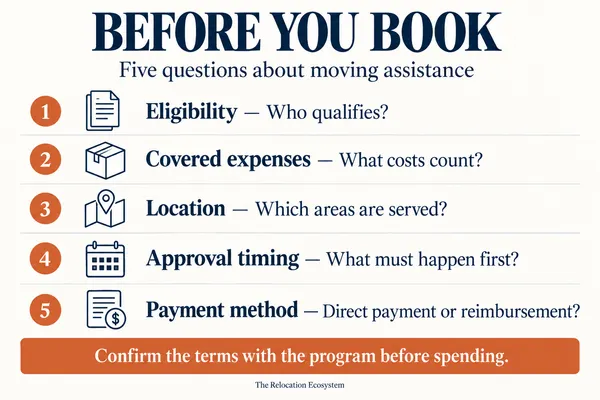
TRE practical checklist: get the following in writing before booking:
- The payment amount, payment date and amount expected to be available after any payroll deductions.
- Covered expenses and separately provided benefits; who books and who signs each contract.
- Whether receipts or spending reports are required, and how unused funds are treated.
- Who pays an overrun, who can approve an exception, and whether repayment conditions apply.
- The contact for a delayed payment, supplier problem or change in the move.
Common misunderstanding
Lump sum funding is different from a binding estimate. One describes an employer benefit; the other describes a mover's pricing commitment for an agreed scope. A lump sum also does not mean full service, and it does not change whether a move is interstate or intrastate.
Example
Hypothetical: an employee receives $5,000 of available relocation funding and books a $3,500 move. The remaining $1,500 may still need to cover travel or temporary accommodation. These figures are illustrative, not a typical package or moving-price benchmark.
TRE common-language definition
Lump sum move: An employee relocation supported by a specified cash benefit, with service coverage, spending responsibilities and support defined by the employer's program and the separate supplier agreements.
Related terms and next steps
Relocation Allowance · Relocation Expense Reimbursement · Estimate · Plan your move.
Sources & Evidence
Weichert's Lump Sum Programs guide describes cash replacing some or all relocation benefits. Sirva's expense-management overview describes lump-sum administration and employee planning support. These are provider descriptions, not universal policy requirements. The checklist and common-language definition are TRE guidance. Confirm payroll treatment and any tax assistance with the employer for the applicable jurisdiction.
Added September 11, 2026. Explore the Relocation Dictionary →


Add your perspective
What does your experience add?
Which part of this guidance matches your experience—and which needs a different perspective?
Share one example, your role and any supporting evidence. Disagreement is welcome when it helps clarify the decision.