
Why Moving Software and AI Need Standardized Move Data
How survey information can travel consistently into estimating, operations and crew instructions, with proposed fields for standardized move data and a practical handoff test.

Published 16 Aug 2026 · Updated 11 Sep 2026. Sources, scope and corrections
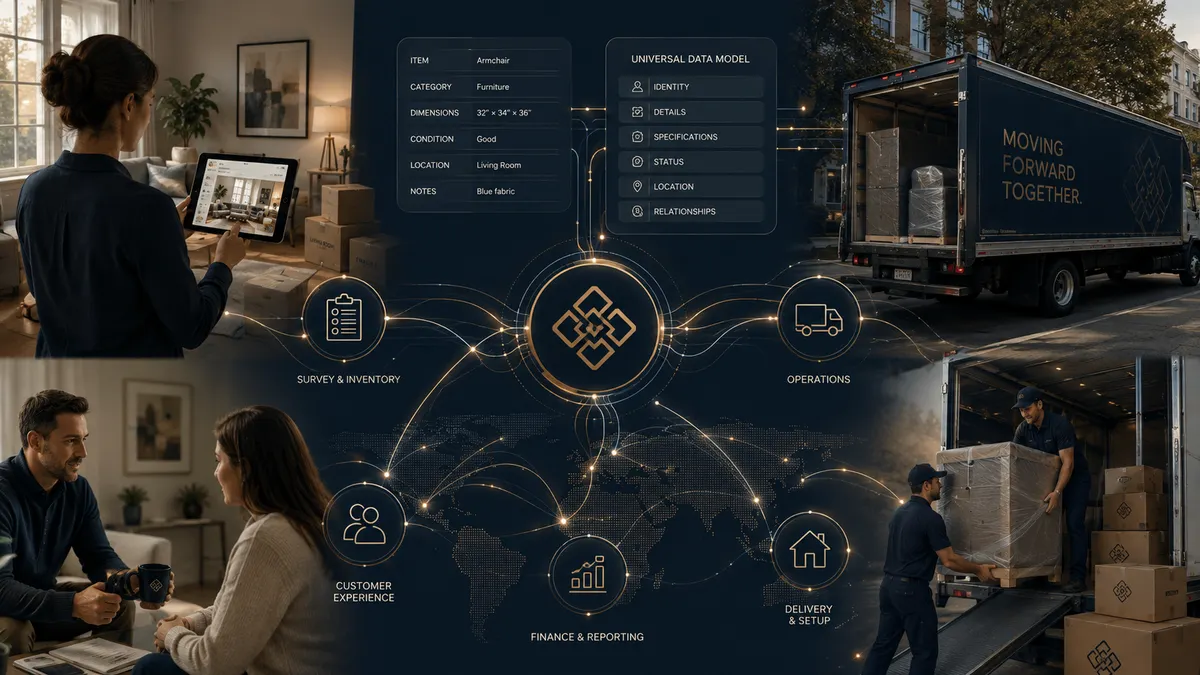
A survey records a sofa, an estimating system assigns space and labor, and a crew receives the job details. The useful test is whether the item, its handling requirements and the latest approved scope still mean the same thing at each handoff.
This article examines the information that moving software needs to exchange: item identity, units, access conditions, service responsibilities and authorized changes. It develops the technology side of TRE’s broader argument for a shared relocation language.
The aim is a move record that different tools and people can interpret consistently. The design questions below are TRE proposals for discussion, not an adopted industry data standard.
The Industry Has Plenty of Technology. What It Lacks Is Translation.
The moving industry is not short on software.
There are CRMs, survey tools, estimating platforms, dispatch systems, inventory applications, routing tools, customer portals, claims platforms, payment systems, and increasingly, AI-enabled products designed to improve one part of the relocation process.
Many of these tools are useful. Some are excellent.
But useful technology does not automatically create a connected operation.
The problem appears when one platform describes a move one way, another stores the information differently, a salesperson interprets it one way, operations interprets it another, and the crew receives whatever survives the handoff.
At that point, the industry is not suffering from a lack of data.
It is suffering from a lack of shared meaning.
A sofa should not become three different things depending on which system is looking at it. A flight of stairs, long carry, elevator restriction, shuttle requirement, fragile item, packing need, or access condition should not require a new interpretation every time the information moves from one company or platform to another.
Technology becomes exponentially more valuable when the information moving through it means the same thing to everyone receiving it.
The First Step Is a Shared Source of Truth
The relocation process begins with information.
Before a truck is dispatched, before labor is scheduled, before packing materials are ordered, before pricing is finalized, and before a customer can reasonably understand what to expect, someone has to describe the move.
That description becomes the foundation for everything that follows.
If the original information is incomplete, inconsistent, or translated differently from one system to another, every downstream decision becomes less reliable.
This is why the survey process matters so much.
A modern survey should be more than a digital inventory. It should become the first structured record of the move—a source of truth that can be understood by sales, operations, crews, customers, carriers, technology platforms, and service partners without repeatedly rebuilding the same information.
That means capturing not only what is being moved, but the context around it: access, complexity, handling requirements, packing needs, customer expectations, timing, location conditions, and other operational factors that directly affect execution.
The goal is not to centralize every company into one system. The goal is to create information that can travel between systems without losing its meaning.
What should travel with a structured move record?
A useful starting point is to test these fields against the survey, estimate and crew instructions for the same move:
- Item identity and quantity: keep an identifier with each item or grouped lot so a renamed description does not silently create a different record.
- Units and measurement basis: distinguish measured dimensions, estimated volume, estimated weight and scale weight. Carry the unit and method with the number.
- Handling and access: record packing responsibility, special handling, stairs, elevators and other restrictions with the location they describe.
- Service responsibility: identify which party is expected to pack, dismantle, transport, store, reassemble or remove materials, and which commitments remain unconfirmed.
- Version and authorization: record what changed, when, who proposed it and who approved it. Link a change of scope to the affected items and services.
- Receipt and exceptions: make it possible to check which downstream team received the update and what remains unresolved before work starts.
For a hypothetical test, add one item after the first survey and change delivery from ground-floor access to an elevator reservation. Follow both changes into the estimate, dispatch instructions and crew record. The test succeeds only when the affected people can identify the current information and outstanding approvals; copying the same text into several systems is not enough.
AI Is Only as Useful as the Language Beneath It
Artificial intelligence is already changing how relocation information can be collected, interpreted, and used.
Computer vision can identify objects. AI can help categorize inventories, recognize patterns, summarize customer information, support estimating, and eventually assist with increasingly complex operational decisions.
But identifying an object is not the same thing as understanding what that object means to a mover.
A sofa is not simply a sofa.
Its dimensions may affect truck space. Its construction may affect handling. Its location may affect labor. Its condition may affect documentation. Its value may affect protection. Its access path may affect equipment, crew size, timing, and risk.
That is where industry-specific intelligence becomes critical.
The most promising moving technologies will not simply connect relocation companies to consumer-ready AI tools. They will build moving-specific layers around those capabilities—using industry knowledge, structured information, operating history, and feedback from actual moves to improve what the technology understands.
Platforms such as BundleBox.ai are interesting in this context because the opportunity is larger than simply recognizing items from images or video. The greater value is in building intelligence around what those items mean throughout the relocation process.
AI can help us speak faster. The real breakthrough will come when the industry agrees on what the words mean.
Better Information Changes the Entire Move
When better information moves through the entire relocation process, the benefits extend far beyond estimating.
Operations can plan labor and equipment with greater confidence. Crews can arrive better prepared. Sales can set clearer expectations. Customers can receive more consistent communication. Specialized handling requirements can be identified earlier. Potential access problems can be addressed before move day instead of becoming surprises at the curb.
That matters financially as well.
A move that is poorly understood at the beginning can create additional labor, overtime, truck-space problems, rescheduling, claims exposure, customer dissatisfaction, and unnecessary pressure on the crew. Each breakdown may look small on its own, but together they directly affect profitability.
The opposite is also true.
Better information can reduce avoidable friction, improve crew productivity, protect margins, increase customer confidence, and allow companies to make better decisions about the work they accept and how they service it.
And importantly, this should not become another conversation where technology is designed only for the office.
The driver and moving crew are where planning becomes reality. If the information collected by our systems does not help the people standing at the customer’s home understand what they are walking into, then we have missed one of the most important opportunities technology can provide.
The strongest technology should make the move clearer for everyone—from the customer making the first inquiry to the crew closing the truck doors at the end of the job.
A Common Language Does Not Require a Common Company
The moving and relocation industry is never going to operate as one company.
Nor should it.
Independent movers, van lines, relocation management companies, technology providers, carriers, suppliers, and service partners all bring different strengths to the process.
The opportunity is not to eliminate those differences.
It is to reduce the friction between them.
A shared language could allow companies to exchange critical move information more consistently without requiring everyone to use the same software, pricing model, operating structure, or business philosophy.
That is what an ecosystem should do.
It should allow independent participants to remain independent while making the connections between them stronger.
If a survey creates structured information that can be understood by the mover, the carrier, the crew, the customer, and the technology supporting them, then each participant can do its own job better without having to recreate the move from the beginning.
That is where cooperation becomes operational rather than philosophical.
The future of relocation may depend less on building one system that controls everything and more on building a common language that allows many systems to work together.
The Question We Should Be Asking
The moving industry does not need to agree on every process, every platform, or every business model.
But there may be certain pieces of information that should mean the same thing everywhere.
That is the conversation worth having now.
Not simply:
What can AI do?
Not simply:
Which software is better?
And not simply:
Who owns the customer?
The more important question may be:
What should every participant in a move be able to agree is true?
If the industry can begin answering that question, we can build better technology around it.
We can create better handoffs.
We can give crews better information.
We can set clearer customer expectations.
We can create stronger partnerships.
And we can begin building a relocation ecosystem where better service and stronger profitability are not competing ideas.
That is the purpose of The Relocation Ecosystem.
Not to suggest that one company has the answer.
But to create a place where the people actually doing the work can begin developing better answers together.
So I would like to start with one question:
If you could standardize one piece of information across the entire moving and relocation industry tomorrow, what would it be?
I would genuinely like to hear the answer—from movers, drivers, crews, estimators, operations teams, technology providers, RMCs, van lines, suppliers, and anyone else whose work touches a relocation.
Because before we build the next generation of technology, we may need to agree on the language it should speak.
Continue with the connected guidance
Read the shared-language thesis for the industry-wide argument, use the Relocation Dictionary to clarify individual terms, and compare how the moving documents describe the agreed move. The ECA and EY research note separately reviews reported adoption and data-readiness findings.
Editorial update: September 11, 2026. Refocused on software and AI data handoffs, with a proposed record checklist and hypothetical test.
Add your perspective
What does your experience add?
Which part of this guidance matches your experience—and which needs a different perspective?
Share one example, your role and any supporting evidence. Disagreement is welcome when it helps clarify the decision.