
The Relocation Industry Does Not Have a Technology Problem. It Has a Language Problem.
The relocation industry is adopting AI and new technology at record speed. But without a shared language and one source of truth, we may simply automate confusion.

Published 26 Aug 2026 · Updated 15 Sep 2026. Sources, scope and corrections
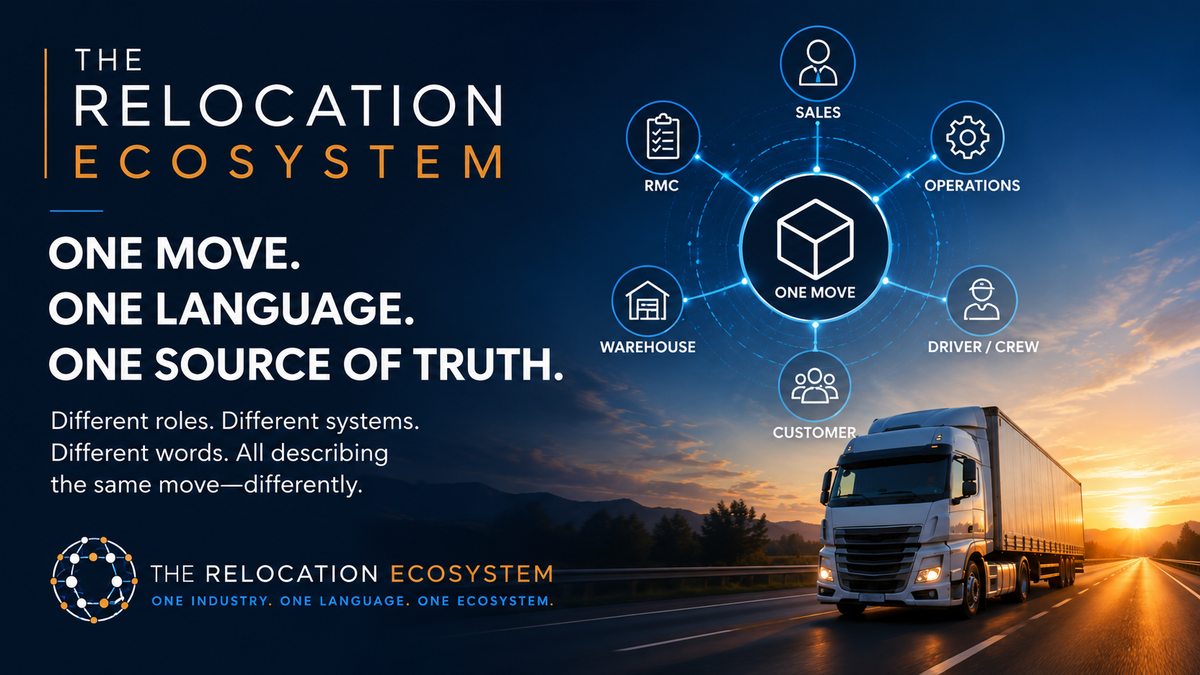
The relocation industry is investing heavily in technology.
Artificial intelligence. Digital surveys. Automated estimating. CRMs. Customer portals. Transportation management systems. Inventory platforms. Pricing tools. Driver applications. APIs.
And yet one of the most basic problems in relocation remains largely unchanged.
We still do not always speak the same language.
A customer says they are moving a three bedroom home.
Sales sees an estimated weight or volume.
Operations sees trucks, labor and capacity.
The driver sees inventory, access and execution.
The warehouse sees vaults and storage requirements.
The relocation management company sees policy and authorization.
The technology platform sees data fields.
The customer simply sees one move.
All of those people may be talking about exactly the same relocation while describing completely different versions of it.
That is not simply a communication problem.
It is an ecosystem problem.
What happens when the language changes from one handoff to the next?
Think about something as simple as a change in scope.
The customer adds several items.
What does that mean?
To the customer, it may be a small addition.
To the salesperson, it may change the estimate.
To operations, it could change labor requirements.
To the driver, it may mean additional space is required.
To the destination team, it could alter delivery time.
To accounting, it may change the final charges.
To a relocation manager, it may require authorization.
One change.
Seven different interpretations.
And somewhere along the way, the responsibility for reconciling those interpretations often lands on the person physically standing in front of the customer.
That is frequently the driver, crew leader or mover.
The person closest to the customer can end up carrying the greatest responsibility while having the least visibility into the decisions that created the move.
That should concern us.
Technology cannot fix a language that has never been standardized
AI is going to become increasingly important in relocation.
I believe that.
But AI cannot solve a problem we have not clearly defined.
If five systems call the same item five different things, artificial intelligence can process that information faster, but it does not necessarily make the information more accurate.
If a survey platform identifies inventory one way, the estimating system converts it another way, operations interprets it differently and the crew sees something else, we have not created automation.
We have automated translation.
And every translation creates another opportunity for information to change.
The goal should not simply be connecting more systems.
The goal should be creating one shared understanding of the move.
The McDonald's problem
There is a reason large organizations standardize language and process.
If I order a hamburger at a McDonald's in Dallas and then order one at a McDonald's in New York, I have a fairly good idea what I am going to receive.
That consistency is not accidental.
The product has a definition.
The process has a definition.
The expectations have a definition.
Imagine if every McDonald's location independently decided what the word hamburger meant.
One location measured ingredients by weight.
Another measured them by volume.
Another called a cheeseburger a hamburger.
Another decided the bun was optional.
Technology would not solve that problem.
The company would first need to agree on what the product actually was.
Relocation is obviously far more complex than making a hamburger.
But the principle is worth considering.
Before an industry can automate a process, it has to agree on the language describing that process.
One move should have one source of truth
This is where I believe the relocation industry has an enormous opportunity.
Imagine a move beginning with a digital survey.
Every item is identified and classified using a common language.
That information becomes the original source of truth.
The salesperson works from it.
The estimator works from it.
The customer approves it.
Operations plans from it.
The warehouse receives it.
The driver sees it.
The crew works from it.
The destination team receives it.
Billing reconciles against it.
When something changes, the change becomes part of that same record.
Not another spreadsheet.
Not another email.
Not another text message.
Not another handwritten note.
Not another version of the inventory.
One move. One language. One evolving source of truth.
Now technology becomes much more powerful.
AI can identify changes.
Pricing can respond.
Capacity can adjust.
Customers can see what changed.
Operations can understand the impact.
Drivers can know what they are walking into.
And accountability becomes clearer because the system can show when a decision was made and who made it.
Accountability should follow the decision
This may be one of the most important consequences of creating a shared language.
Today, accountability sometimes follows execution rather than decision making.
A salesperson changes something.
Operations reacts.
A customer adds something.
A coordinator approves something.
A system misses something.
Then the crew arrives.
When the move does not go as planned, the person completing the move may be asked to solve the problem.
But responsibility should not automatically fall to the last person in the chain.
Accountability should follow the decision.
If the scope changed, we should know when.
If pricing changed, we should know why.
If additional services were approved, everyone affected should see them.
If inventory changed, the driver should not discover it at the front door.
This is not about assigning blame.
It is about creating clarity.
And clarity is one of the foundations of a healthier ecosystem.
This will require cooperation
No single mover can create this standard.
No single relocation management company can create it.
No single software provider can create it.
No single van line can create it.
No single AI company can create it.
The language has to be developed by the people who actually participate in relocation.
Movers.
Drivers.
Crews.
Sales teams.
Operations professionals.
RMCs.
Technology companies.
Survey providers.
Warehouses.
Claims professionals.
Customers.
Each sees a different part of the process.
That is exactly why they need a common language connecting those parts.
The goal should not be forcing everyone onto the same software.
Competition is healthy.
Innovation is necessary.
Different companies should continue developing better technology.
What should be shared are the fundamental definitions that allow those technologies and people to understand one another.
This is bigger than software integration
For years, our industry has talked about integration.
Connecting system A to system B.
Connecting survey tools to estimating systems.
Connecting movers to RMC platforms.
Connecting customers to portals.
Those connections matter.
But integration without standardization can simply connect different interpretations faster.
The opportunity now is larger.
We can begin defining the common language those systems use when they communicate.
What is an item?
What is a service?
What constitutes a change?
When does that change become effective?
Who authorized it?
What operational impact does it create?
What information must follow the move?
Who becomes responsible for acting on that information?
Those questions may sound basic.
They are not.
They could become the foundation upon which the next generation of relocation technology is built.
The Relocation Ecosystem begins here
This publication was created around a simple belief.
The relocation industry does not improve because one company builds a better piece of software.
It improves when the different parts of the industry begin working together more effectively.
Technology will absolutely be part of that future.
Artificial intelligence will be part of it.
Automation will be part of it.
But before we ask machines to understand relocation, perhaps we should make sure we understand one another.
One move.
One source of truth.
One shared language.
Shared accountability.
Different companies. Different technologies. Different roles.
One ecosystem.
The question is no longer whether the relocation industry will become more connected.
It will.
The question is:
What language are we going to use when everything finally connects?
Join the conversation
The Relocation Ecosystem is being built as a place for movers, drivers, crews, technology companies, relocation professionals and industry leaders to discuss questions exactly like this.
If you believe our industry can become more connected, more transparent and more accountable, Join the Ecosystem.
And I would especially like to hear your answer to one question:
What is one word, process or definition in relocation that our industry desperately needs to standardize?


Add your perspective
What does your experience add?
Which part of this guidance matches your experience—and which needs a different perspective?
Share one example, your role and any supporting evidence. Disagreement is welcome when it helps clarify the decision.