
How to Prepare for a Virtual Moving Survey
Learn how to prepare for a guided or self-guided virtual moving survey, what to show, what people often miss, and how to reduce surprises on moving day.

Published 9 Sep 2026 · Updated 10 Sep 2026. Sources, scope and corrections

What to show, what not to forget, and how to help your mover understand the move
A virtual survey sounds more complicated than it really is.
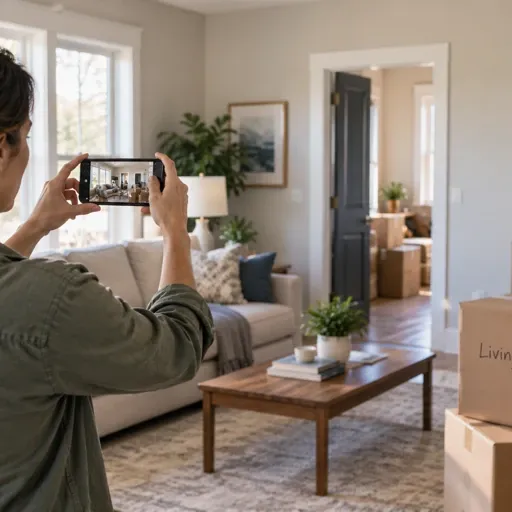
In most cases, you are simply using your phone to walk through your home and show what needs to be moved.
That's it.
You do not need professional lighting. You do not need to make a polished video. And you definitely do not need to clean the house before you start.
What matters is that the survey gives the mover a realistic picture of the job.
That includes the obvious things—the sofa, beds, dressers and boxes.
But it also includes the things that are easy to forget:
the hall closet packed to the ceiling, the garage, the patio furniture, the treadmill upstairs, the items stored in the attic, the narrow staircase, or the fact that the moving truck cannot park anywhere near the front door.
Those details matter.
The better the mover understands the move before moving day, the easier it is to plan the right crew, equipment, time and services.
So let's walk through how to do a good survey.
First: What Kind of Virtual Survey Are You Doing?
Not every virtual survey works the same way.
Generally, you will run into one of two formats:
a Guided Survey
or
a Self-Guided Survey.
Both are designed to help the mover understand what you are moving without having to send someone physically to your home.
But the experience is a little different.
Guided Survey
Think of a Guided Survey as an in-home survey where the estimator happens to be on your phone instead of standing in your living room.
You normally join a live video session with a mover, estimator, surveyor or relocation professional.
You hold the phone.
They guide the walkthrough.
They may say things like:
“Can you open that closet for me?”
or:
“Can you show me the other side of that sectional?”
or:
“Is the garage included in the move?”
or:
“How many flights of stairs are there at destination?”
The biggest advantage is that you have another person helping make sure important things are not overlooked.
If the surveyor sees something unusual, they can ask about it immediately.
If you are not sure whether something matters, you can ask.
A Guided Survey may be a good choice when:
- you have a larger home;
- you have a lot of furniture or storage;
- you have unusual or specialty items;
- you need substantial packing;
- the move has complicated access;
- you have never done a virtual survey before;
- or you simply feel more comfortable having someone walk you through it.
It can also be especially useful when the move itself is complicated.
The technology gives you the convenience of staying home while the surveyor still provides real-time judgment.
Self-Guided Survey
A Self-Guided Survey puts more of the walkthrough in your hands.
Instead of scheduling a live appointment with an estimator, you normally receive a link or instructions and complete the survey yourself.
The software may guide you room by room.
You may record short videos.
You may answer questions.
You may identify rooms, packing needs or access conditions.
Depending on the platform, software may also help identify the items shown in the video and organize them into an inventory for the mover to review.
When you are finished, the survey information is submitted for review.
The major advantage is convenience.
You may be able to complete it:
when you have time, at your own pace, without coordinating an appointment.
That can be a big benefit for a busy family.
A Self-Guided Survey may be a good choice when:
- your move is fairly straightforward;
- you are comfortable using your phone;
- your schedule makes appointments difficult;
- you want to complete the survey in the evening or on your own time;
- or the technology provides clear room-by-room instructions.
But there is one important difference:
Nobody is standing there virtually reminding you to open the closet.
That means you have to be a little more deliberate.
Which One Is Better?
There really is not one answer for every move.
A Guided Survey gives you more human assistance.
A Self-Guided Survey gives you more flexibility.
One may be better for one customer and unnecessary for another.
I would think about the decision this way:
Guided Survey
Best feature: Someone is helping you in real time.
Customer effort: Lower decision burden because the surveyor can prompt you.
Scheduling: Usually requires an appointment.
Questions: You can ask them immediately.
Risk of forgetting something: Potentially lower because another person is watching the walkthrough.
Self-Guided Survey
Best feature: You can usually complete it on your schedule.
Customer effort: You are more responsible for showing everything.
Scheduling: Often much more flexible.
Questions: May need to be handled before or after the survey.
Risk of forgetting something: Depends heavily on how carefully you follow the prompts and walk the home.
There Is Also a Middle Ground
Technology is beginning to blur the line between the two.
A Self-Guided Survey does not necessarily mean:
“Here is a camera. Good luck.”
Some platforms can provide:
- room-by-room prompts,
- instructions on what to show,
- automated item recognition,
- visual inventory creation,
- and checks designed to make the survey easier to complete.
At the same time, guided platforms may use the same type of technology while also keeping a live surveyor involved.
So the more useful question may not be:
“Is there a person on the call?”
It may be:
“Who—or what—is helping make sure the move is captured completely?”
That could be a human surveyor.
It could be well-designed software.
Or it could be both.
Tools such as BundleBox.ai are part of this newer generation of virtual-survey technology, where a customer walkthrough can become structured inventory and useful move information rather than just a raw video.
No Matter Which Survey You Choose, Your Job Is Still the Same
Whether someone is guiding you live or you are doing the survey yourself, the goal does not change.
You want the mover to understand:
what is moving,
what services you need,
what could be difficult,
and
what the move actually looks like.
The rest of this guide applies to both types.
If you are doing a Self-Guided Survey, pay especially close attention to the reminders about closets, garages, storage areas and access.
If you are doing a Guided Survey, do not assume the surveyor can see everything automatically.
They can only see where you point the camera.
First, don't worry about how the house looks
This is worth saying upfront.
You do not need to clean your house for a virtual survey.
The person reviewing the survey is not there to judge your housekeeping.
They need to see your belongings.
In fact, hiding things in closets so the room looks nicer can make the survey less accurate.
If it is moving, let them see it.
Before You Start
A few minutes of preparation will make the whole process easier.
Charge your phone
This sounds obvious until your phone hits 4% halfway through the garage.
Start with a reasonably charged battery.
If you have a larger home, it may also make sense to keep a charger nearby.
Turn on the lights
You want the camera to be able to see what you are showing.
Turn on lights in:
- bedrooms,
- closets,
- the garage,
- basement areas,
- storage rooms,
- and other darker spaces.
Open blinds or curtains if it helps.
You are not creating a movie.
You are simply helping the camera see the room.
Check your connection
If someone is walking through the home with you over a live Guided Survey, make sure your Wi-Fi or cellular connection works throughout the house.
If you are completing a Self-Guided Survey that records information for later upload, this may matter less while you are walking the home.
Different tools work differently, so follow the instructions provided with your survey.
Think about what is staying behind
Before you start, identify anything that is not moving.
Then say so when you reach it.
For example:
“The dining table is going, but that cabinet is staying with the house.”
Simple.
You do not need special moving terminology.
You just need to be clear.
Pick a Starting Point and Keep Moving in One Direction
One of the easiest ways to miss something is to wander around the house randomly.
Start somewhere logical.
Maybe the front door.
Then work your way through the home.
For example:
Living room → dining room → kitchen → bedrooms → closets → office → garage → patio → storage areas
Your exact route does not matter.
Consistency does.
If your Self-Guided Survey gives you room-by-room prompts, follow them.
If you are doing a Guided Survey, let the surveyor know when you have finished one area and are moving to another.
The goal is simply to avoid getting to the end and realizing:
“I completely forgot the garage.”
Slow Down
This may be the single best piece of advice in the entire article.
Move the phone slower than you think you need to.
People naturally move a camera quickly when they are showing someone around.
The problem is that what feels normal while you are holding the phone can look like a blur to the person—or software—trying to identify everything later.
When you enter a room, pause.
Give a slow view of the whole room.
Then move closer to the individual pieces.
If there is a large dresser, pause on it.
If there is a sectional sofa, show the entire sectional.
If something is hidden behind another piece of furniture, point it out.
You are not trying to impress anyone with the video.
You are trying to make the move understandable.
Open the Closets
Yes, all of them.
Closets are one of the easiest ways for a move to be underestimated.
A closed closet door could mean:
- three jackets,
or
- forty hanging garments, twelve pairs of shoes, six storage tubs, luggage, boxes and a vacuum cleaner.
Those are very different moves.
Open the door and show what is inside.
The same goes for:
- linen closets,
- coat closets,
- pantries,
- under-stair storage,
- utility rooms,
- and other storage spaces.
You do not have to open every kitchen drawer and show every fork.
Use common sense.
But if there is a meaningful amount of stuff somewhere, show it.
Please Don't Forget the Garage
If there is one area I would tell customers to slow down and really look at, it is the garage.
Garages hold a surprising amount of stuff.
Show:
- tools,
- shelving,
- boxes and tubs,
- bicycles,
- lawn equipment,
- ladders,
- workbenches,
- refrigerators or freezers,
- exercise equipment,
- outdoor gear,
- and items hanging on the walls.
Look up too.
Some garages have things stored overhead.
And don't stop with the garage.
If you have a:
- shed,
- attic,
- basement,
- detached building,
- storage room,
- or off-site storage unit
that is part of the move, it needs to be part of the survey.
The survey cannot include what nobody knows exists.
“But I Haven't Packed Yet.”
That's fine.
You are usually not expected to have everything packed before the survey.
The important thing is showing what will eventually go into boxes.
If the kitchen cabinets are full, show them.
If a bookshelf is full of books, show it.
If the children's room has toys everywhere, show them.
If you have a closet filled with holiday decorations, show it.
You do not necessarily need to guess:
“That's going to be exactly 47 boxes.”
Give the mover enough information to make a reasonable assessment.
Point Out the Things That Aren't Ordinary
Some items deserve extra attention.
If you have something especially:
- heavy,
- fragile,
- valuable,
- oversized,
- or difficult to move,
stop and show it clearly.
That might include:
- a piano,
- safe,
- pool table,
- large artwork,
- antique furniture,
- marble or stone,
- grandfather clock,
- large mirror,
- exercise machine,
- unusual appliance,
- or oversized piece of furniture.
You do not have to know whether the moving company officially considers something a “specialty item.”
Just say:
“I want to make sure you see this.”
That's enough.
Let the mover decide what additional planning is required.
Show Anything That Needs to Be Taken Apart
If a piece of furniture may need to be disassembled, show it.
Think about:
- beds,
- large dining tables,
- sectional sofas,
- desks,
- shelving units,
- exercise equipment,
- wall units,
- or unusually large furniture.
If you assembled something after bringing it into the room and you are wondering how it will ever get back through the door, mention that too.
Moving crews solve those problems every day.
They just need to know the problem exists.
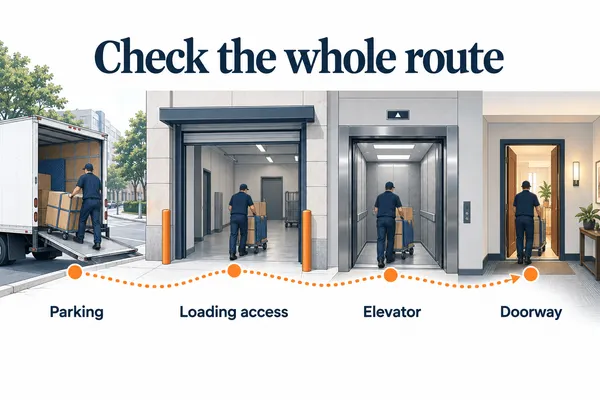
Show the Path to the Truck
Here is something customers understandably miss:
The survey is not only about what you own.
It is also about how the mover gets it out of the house.
A sofa sitting 20 feet from a moving truck is one thing.
That same sofa going down three flights of stairs, through a long hallway and 200 feet across a parking lot is another.
Show or explain:
- stairs,
- elevators,
- narrow hallways,
- tight corners,
- long walks,
- gated entrances,
- loading docks,
- steep driveways,
- restricted parking,
- and anything else that could make access difficult.
If you already know the situation at the new home, tell the mover about that too.
For example:
“We are moving into a third-floor apartment and there is no elevator.”
That's important information.
Who Is Doing the Packing?
Do not leave this vague.
Tell the mover whether:
- you are packing everything,
- the mover is packing everything,
- the mover is only packing certain fragile items,
- you need wardrobe cartons,
- you need special crating,
- or you simply haven't decided yet.
You are allowed to say:
“I'm not sure yet.”
The important thing is that everyone knows the packing plan still needs to be finalized.
Packing affects time, materials, labor and price.
Is Anything Likely to Change?
A virtual survey captures your move today.
Moving day may still be weeks away.
Things change.
Maybe you are going to sell the guest-bedroom furniture.
Maybe you are buying a new sectional before the move.
Maybe your spouse has finally agreed that the contents of the garage do not all need to make the trip.
Maybe you discover another storage unit.
Tell the mover what you know.
Then, if the move changes significantly after the survey, update them.
A virtual survey is not supposed to freeze your life in place.
It is supposed to give everyone the best available picture of the move.
One Important Privacy Reminder
While you are walking through the home, remember that the purpose of the survey is to document the move.
There is usually no reason to deliberately film:
- financial statements,
- passwords,
- computer screens,
- medical information,
- identification documents,
- account numbers,
- or other sensitive personal information.
If something private is sitting on a desk or counter, move it out of view if practical.
The survey needs to see your furniture and household goods.
It does not need to know everything about your life.
Before You Hit Finish
Take one last mental walk through the property.
Ask yourself:
- Did I show every room?
- Did I open the closets and important storage areas?
- Did I include the garage, attic, basement, shed, patio or storage unit?
- Did I explain what is not moving?
- Did I point out anything unusually heavy, fragile or large?
- Did I show stairs, elevators, parking and access?
- Did I explain what still needs to be packed?
If you are doing a Self-Guided Survey, I would actually walk through those seven questions before submitting.
If you are doing a Guided Survey, ask the surveyor:
“Is there anything else you need me to show you before we finish?”
That is a very good last question.
Then Read the Estimate
This part matters.
The virtual survey is not necessarily the estimate.
The survey helps gather information.
The mover still needs to turn that information into the actual proposed scope and price.
When the estimate or proposal arrives, read it.
Make sure it reflects the move you showed.
Look for things such as:
- missing rooms,
- missing furniture,
- specialty items,
- packing services,
- storage,
- access conditions,
- valuation or liability choices,
- and pickup or delivery expectations.
If you showed a piano and the paperwork does not mention a piano, ask about it.
If you discussed packing and the estimate shows none, ask about it.
This is the best time to fix misunderstandings.
Not after the truck arrives.
What Technology Can—and Cannot—Do
Virtual-survey technology has come a long way.
Platforms such as BundleBox.ai and other virtual-survey tools can make it much easier to capture a walkthrough and turn what the customer shows into organized inventory and useful information for planning the move.
That is valuable.
But even very good technology has one obvious limitation:
It cannot see the closet you never opened.
That is why I think of a good virtual survey as a shared job.
You show the move.
The technology helps organize what you showed.
The mover reviews it.
Then everyone makes sure they are talking about the same move.
Whether the process is Guided or Self-Guided, that principle stays the same.
The real value is not just making the estimate faster.
It is making the move clearer before moving day.
One Move. One Understanding.
Most moving problems do not begin with something dramatic.
They begin with two people believing two different things about the same move.
The customer thought something was included.
The mover did not know it existed.
The access was harder than expected.
The packing plan was unclear.
The inventory changed and nobody updated it.
A good virtual survey cannot prevent every problem.
But it can remove a lot of unnecessary uncertainty.
So whether someone is guiding you live or you are completing the survey on your own:
take your time.
Open the closet.
Show the garage.
Mention the treadmill.
Point out the stairs.
And if you are not sure whether something matters, show it anyway.
A few extra seconds during the survey can make moving day a whole lot easier.
The Relocation Ecosystem
One move. One language. Shared accountability.


Add your perspective
What does your experience add?
Which part of this guidance matches your experience—and which needs a different perspective?
Share one example, your role and any supporting evidence. Disagreement is welcome when it helps clarify the decision.