
Employment-Linked Relocation Readiness Checklist
Your job ended—or may be ending—and your U.S. immigration status may be connected to your employment. You do not need to know where you are moving yet to start getting organized.

Published 10 Sep 2026 · Updated 10 Sep 2026. Sources, scope and corrections

Your job ended—or may be ending—and your U.S. immigration status may be connected to your employment. You do not need to know where you are moving yet to start getting organized.
Last reviewed: September 10, 2026
Start here
If your immigration status is connected to your employment, confirm your individual immigration situation with qualified U.S. immigration counsel before making irreversible relocation decisions.
A proposed or changing immigration rule is not enough to determine what applies to you.
USCIS has historically recognized that employment-based nonimmigrant workers whose employment has ended may, depending on their individual circumstances and eligibility, have options other than immediate departure. Those determinations are legal questions. USCIS: Options for Nonimmigrant Workers Following Termination of Employment.
This checklist addresses the household and relocation side of the problem.
Use it to prepare for three possibilities:
A. We remain where we are.
B. We remain in the United States but relocate.
C. We leave the United States.
You can prepare for all three without committing to any one of them.
1. Immigration and legal facts
Do this first.
☐ Identify qualified U.S. immigration counsel.
☐ Confirm the immigration classification of each affected family member.
☐ Confirm the legally relevant date employment ceased or will cease.
☐ Ask counsel what period of authorized stay, grace period, filing option or other provision applies to your circumstances.
☐ Ask whether another employer, petition, application or change of status could affect your situation.
☐ Ask separately about your spouse and each dependent.
☐ Determine whether a spouse's work authorization may be affected.
☐ Record important immigration dates in one place.
☐ Keep copies of passports, visas, Forms I-94, Forms I-797 and other immigration documents accessible.
☐ Do not pack original immigration documents in household goods.
Decision gate
Before authorizing an international move, ask:
Do we understand our realistic legal options and timing well enough to make this relocation decision?
If not, continue preparing while identifying which decisions can safely wait.
2. Employment and employer support
☐ Confirm the official last day of employment.
☐ Identify the HR contact responsible for termination questions.
☐ Identify the mobility or relocation contact, if one exists.
☐ Obtain the applicable severance agreement.
☐ Obtain the applicable relocation or repatriation policy.
☐ Confirm when health and other employee benefits end.
☐ Ask whether immigration counsel provided by the employer remains available after termination.
☐ Ask whether return transportation is provided.
☐ Ask exactly who return transportation covers.
☐ Ask whether household-goods transportation is included.
☐ Ask whether packing is included.
☐ Ask whether storage is included.
☐ Ask whether temporary housing is included.
☐ Ask whether lease-termination assistance is included.
☐ Ask whether vehicle transportation is included.
☐ Ask whether destination services are included.
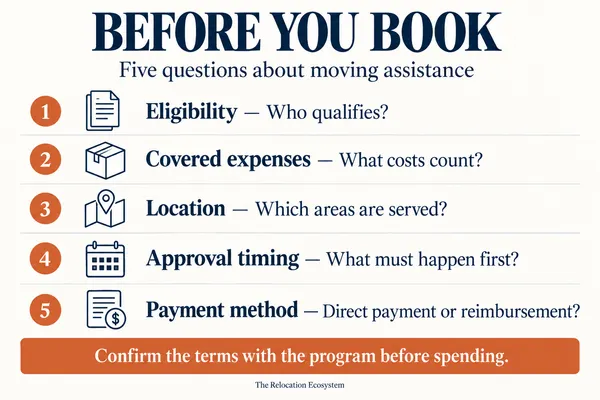
☐ Determine whether expenses are paid directly or reimbursed later.
☐ Identify spending limits.
☐ Identify deadlines for using benefits.
☐ Get important benefit information in writing.
Remember
Return transportation is not automatically the same thing as a full relocation benefit.
Airfare, family transportation, household goods, storage, housing and destination support can be treated separately.
3. Build your three household scenarios
Complete this even if one outcome seems much more likely.
Scenario A — We remain where we are
☐ Can we continue our current housing?
☐ Can we afford it if household income changes?
☐ Are schools and childcare unchanged?
☐ Will the end of any employer-provided benefits affect the decision?
☐ Have we avoided unnecessary moving expenses while the situation remains uncertain?
Scenario B — We remain in the U.S. but move
☐ What cities or markets are realistic?
☐ Would a new employer provide relocation assistance?
☐ Would temporary housing be needed?
☐ What would a domestic household-goods move require?
☐ Would vehicles move with us?
☐ What school or childcare transition is required?
☐ What date could the move realistically occur?
Scenario C — We leave the United States
☐ What country or destination is realistic?
☐ Do we have permanent housing there?
☐ If not, where would we stay initially?
☐ Where would household goods be delivered?
☐ Would temporary storage be required?
☐ What customs or import requirements apply?
☐ What happens to vehicles?
☐ What happens to pets?
☐ What happens to schools?
☐ What banking, healthcare and insurance transitions are required?
4. Housing
If you rent
☐ Locate your signed lease.
☐ Identify the required notice period.
☐ Review early-termination provisions.
☐ Determine possible penalties.
☐ Understand the security-deposit process.
☐ Check whether subleasing or assignment is permitted.
☐ Determine whether someone could manage the residence if you must leave temporarily.
☐ Get any landlord agreement in writing.
If you own
☐ Determine whether selling is actually necessary.
☐ Estimate realistic selling time rather than assuming an immediate sale.
☐ Evaluate whether renting the property is an option.
☐ Review mortgage obligations.
☐ Review homeowners insurance requirements.
☐ Determine whether a property manager would be needed.
☐ Identify a trusted local contact if you leave before the property is resolved.
Avoid
Do not assume losing immigration-linked employment automatically cancels a lease, mortgage or other private contract.
5. Household goods
Walk through the home and put belongings into five categories.
MOVE
Things that should ultimately go to the next permanent home.
☐ Furniture
☐ Clothing
☐ Kitchen items
☐ Personal belongings
☐ Children's items
☐ Other long-term possessions
STORE
Items worth keeping while your destination remains uncertain.
☐ Furniture
☐ Seasonal items
☐ Sentimental items
☐ Items not immediately needed
☐ Goods awaiting a confirmed delivery address
SELL
☐ Furniture expensive to ship relative to value
☐ Appliances incompatible with the destination
☐ Vehicles or equipment impractical to transport
☐ Other easily replaceable items
DONATE / DISPOSE
☐ Low-value furniture
☐ Unneeded household goods
☐ Items prohibited at destination
☐ Items not economical to ship or store
CARRY WITH YOU
These should generally remain under your control:
☐ Passports
☐ Immigration documents
☐ Birth and marriage certificates
☐ Medication
☐ Essential medical information
☐ Financial records
☐ Valuable jewelry
☐ Critical electronics
☐ Employment documents
☐ Moving and storage contracts
☐ Children's essential records
☐ Irreplaceable personal items
6. Storage decision
Storage can create useful flexibility when the household must leave one residence before knowing its final destination.
Ask:
☐ How long might storage realistically be needed?
☐ What is the monthly cost?
☐ What happens if one month becomes six months?
☐ Is the facility appropriate for long-term storage?
☐ Is climate-controlled storage needed?
☐ How is loss or damage covered?
☐ Can someone else access the goods?
☐ Can the goods later be forwarded internationally?
☐ Can the storage provider release goods while you are outside the United States?
☐ What identification or authorization will be required?
☐ How will future payments be handled?
☐ Have you kept an inventory?
Decision question
Would storage preserve flexibility—or merely postpone a decision at significant cost?
7. Children and education
☐ Determine when the current school requires notice.
☐ Obtain copies of report cards and transcripts.
☐ Obtain testing records if relevant.
☐ Obtain special-education or accommodation records if applicable.
☐ Determine whether original records or certified copies are required.
☐ Identify enrollment requirements for likely destinations.
☐ Check how the timing affects exams.
☐ Check how the timing affects graduation.
☐ Investigate temporary schooling if destination housing is not yet permanent.
☐ Consider the emotional effect of uncertainty and repeated transitions.
USCIS has itself recognized, in a separate compelling-circumstances context, that job loss can create major family disruption involving housing, children's education and relocation. That does not establish eligibility for any immigration benefit, but it reinforces why these household dependencies deserve early attention. USCIS: Employment Authorization Documents Based on Compelling Circumstances.
8. Healthcare
☐ Confirm the date employer-sponsored health coverage ends.
☐ Determine available continuation or alternative coverage.
☐ Refill essential medications where appropriate.
☐ Obtain copies of important medical records.
☐ Obtain specialist records.
☐ Obtain dental records if needed.
☐ Identify ongoing treatment that cannot be interrupted.
☐ Determine medication availability at a possible destination.
☐ Identify destination healthcare needs.
☐ Carry essential medication personally.
9. Pets
If international departure is possible, investigate early.
☐ Identify destination-country pet-entry requirements.
☐ Confirm vaccination requirements.
☐ Confirm microchip requirements.
☐ Determine whether a veterinary health certificate is required.
☐ Determine whether an import permit is required.
☐ Check quarantine rules.
☐ Check airline restrictions.
☐ Verify seasonal temperature restrictions for animal transportation.
☐ Obtain veterinary records.
☐ Identify a pet transporter that meets the relevant airline and destination requirements if professional assistance may be required.
☐ Build a backup plan if the pet cannot travel on the same date as the family.
Some international pet requirements involve waiting periods. Researching them early does not mean committing to departure.
10. Vehicles
For each vehicle, choose the most likely path:
KEEP — SELL — STORE — SHIP DOMESTICALLY — EXPORT
Then ask:
☐ Is the vehicle financed?
☐ Does the lender permit export?
☐ Where is the title?
☐ Would the vehicle comply with destination requirements?
☐ What would shipping cost?
☐ What import duty or tax might apply?
☐ Would selling and replacing be more practical?
☐ If storing it, who will maintain registration and insurance?
☐ If selling it, how much time is realistically required?
11. Financial and administrative matters
☐ Ensure continued access to U.S. bank accounts where appropriate.
☐ Confirm that two-factor authentication will work internationally.
☐ Update critical contact information.
☐ Review credit-card access.
☐ Review automatic payments.
☐ Review subscriptions.
☐ Review utility accounts.
☐ Establish mail-forwarding arrangements.
☐ Identify tax records that should remain accessible.
☐ Keep copies of employment and payroll records.
☐ Review insurance policies.
☐ Identify any accounts that require a U.S. address.
☐ Determine who can handle affairs in the United States if you are abroad.
For legal, tax or financial advice, use the appropriate qualified professional.
12. Destination readiness
Before shipping an entire household internationally, answer:
☐ Where will we sleep when we arrive?
☐ How long can we stay there?
☐ Is it temporary or permanent?
☐ Where will the household-goods shipment be delivered?
☐ Can the destination accept the shipment?
☐ Are customs documents ready?
☐ Who will receive the shipment if we are unavailable?
☐ Do we need storage at destination?
☐ Do we have transportation after arrival?
☐ Do children have a schooling plan?
☐ Do we have access to healthcare?
☐ Do we have working banking and payment options?
☐ Do we have reliable communication?
If the answers are unclear
Consider a staged move:
Current residence → Temporary housing → Storage → Destination decision → Permanent housing → Final household-goods delivery
A staged relocation can sometimes preserve options when circumstances are changing quickly.
13. Provider coordination
Create one contact list.
Immigration
Attorney: __________
Phone/email: __________
Employer HR
Contact: __________
Phone/email: __________
Mobility / relocation
Contact: __________
Phone/email: __________
Moving company
Contact: __________
Estimate / reference number: __________
Storage provider
Contact: __________
Account / reference number: __________
Housing
Landlord / property manager / realtor: __________
Destination contact
Name: __________
Phone/email: __________
Emergency U.S. contact
Name: __________
Phone/email: __________
14. Dates that everyone should agree on
Write these down rather than relying on memory.
Last employment date: __________
Immigration date(s) confirmed by counsel: __________
Housing notice deadline: __________
Move-out date: __________
Packing date: __________
Pickup date: __________
Storage start date: __________
Flight / departure date: __________
Destination availability date: __________
Estimated shipment arrival: __________
Employer benefit deadline: __________
If different professionals are using different dates, resolve the discrepancy before execution.
15. The 24-hour priority list
If your situation suddenly becomes urgent, use this list to organize your first actions. The 24-hour and 72-hour headings are planning aids, not immigration deadlines or reasons to delay urgent advice.
1. People
☐ Contact immigration counsel.
☐ Contact spouse/family decision-makers.
☐ Contact HR/mobility.
2. Documents and medication
☐ Secure passports.
☐ Secure immigration records.
☐ Secure medication.
☐ Secure critical family records.
3. Facts
☐ Confirm employment end date.
☐ Confirm known immigration dates.
☐ Confirm employer support.
☐ Confirm housing obligations.
4. Options
☐ Evaluate remaining where we are.
☐ Evaluate a domestic move.
☐ Evaluate an international departure.
☐ Evaluate temporary housing.
☐ Evaluate storage.
Do not confuse planning an option with committing to it.
16. The 72-hour planning list
Once immediate facts are established:
☐ Obtain moving estimates if a move appears possible.
☐ Investigate storage.
☐ Review lease or home-sale implications.
☐ Investigate likely destination requirements.
☐ Investigate pet requirements.
☐ Determine vehicle options.
☐ Obtain school records.
☐ Obtain essential medical records.
☐ Create household inventory.
☐ Identify what travels personally.
☐ Establish a preliminary budget.
☐ Determine which decisions can still safely wait.
17. Before authorizing a move
Use this final decision gate.
Immigration
☐ Qualified counsel has explained our individual situation.
Destination
☐ We know where we are going—or intentionally have a temporary plan.
Housing
☐ We understand what happens to our current residence.
Household goods
☐ We know which belongings we will move, store, sell, donate or carry with us.
Family
☐ Spouse, children, healthcare and pets have been addressed.
Employer
☐ We understand what the employer is and is not paying for.
Timing
☐ The important parties are working from the same dates.
Money
☐ We understand immediate moving, storage, housing and transportation costs.
Documents
☐ Critical records remain with us.
If several of these remain unanswered, confirm with counsel and your providers which commitments can safely be delayed.
18. Questions to ask a moving or relocation provider
A relocation provider should be able to answer operational questions without giving immigration advice.
Ask:
☐ Can you handle a move with an uncertain destination?
☐ Can you provide temporary storage?
☐ Can stored goods later be forwarded internationally?
☐ Can you handle both domestic and international scenarios?
☐ What information do you need to prepare an estimate?
☐ How quickly can packing occur?
☐ What items cannot be shipped?
☐ What documentation is needed?
☐ How are shipment delays handled?
☐ How are goods protected while stored?
☐ What happens if the destination changes?
☐ What happens if the move is canceled?
☐ What charges become nonrefundable?
☐ Who is responsible for customs coordination?
☐ Who should we contact after leaving the United States?
A responsible relocation provider should tell you when a question belongs with immigration counsel, tax counsel, an attorney or another qualified professional.
One simple rule
When employment, immigration and relocation collide:
Legal reality first.
Household options second.
Irreversible decisions third.
Execution last.
The objective is not to predict what will happen.
It is to be prepared enough that, once you know what needs to happen, your family is not starting from zero.
Related Relocation Ecosystem resources
Start with:
My U.S. Job Ended and My Immigration Status Is Tied to My Employer: What Relocation Decisions Should I Prepare For?
Current-policy context:
DHS Proposes Ending the 60-Day Work-Visa Grace Period: What It Could Mean for Relocation
Coming next:
Who Pays for Your Move Home After an H-1B or O-1 Job Ends?
Important disclaimer
The Relocation Ecosystem provides general educational and relocation information. We are not a law firm, and this checklist is not legal, immigration, tax or financial advice. It does not determine immigration status, authorized stay, filing eligibility, deadlines, employer obligations or whether anyone should remain in or depart the United States. Immigration circumstances are fact-specific. Consult qualified U.S. immigration counsel about your individual situation.


Add your perspective
What does your experience add?
Which part of this guidance matches your experience—and which needs a different perspective?
Share one example, your role and any supporting evidence. Disagreement is welcome when it helps clarify the decision.