
The Crew Shouldn’t Be the First to Discover the Move Has Changed.
Crews should not be the first people to discover that the move no longer matches the plan. Better information before arrival—and better feedback afterward—can improve execution, customer experience, safety, and profitability.

Published 16 Aug 2026 · Updated 16 Aug 2026. Sources, scope and corrections
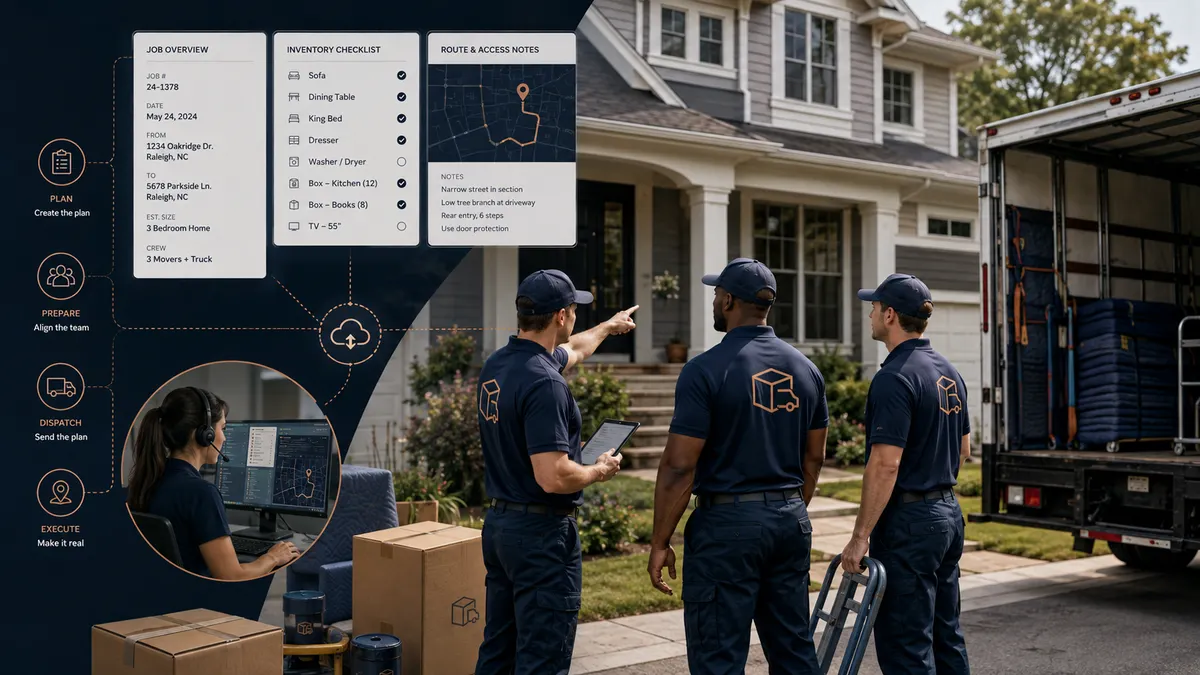
The crew should not arrive at a customer’s home and discover a different move than the one the company planned.
Yet it happens every day.
The inventory changed. Packing was added. Access is worse than expected. The customer believes something was included that operations never saw. A specialty item appears that no one discussed. The labor plan no longer fits the job.
By the time the crew sees the problem, nearly every earlier opportunity to correct it has already passed.
And the people who had the least control over how the move was sold or planned are now standing in front of the customer trying to fix it.
That is not a crew problem. It is an information problem that finally became visible on move day.
Move Day Is Too Late to Discover the Truth
The purpose of a survey, estimate, sales conversation, and operations review is to reduce uncertainty before the move begins.
If the crew arrives and immediately has to reconstruct the job, then the process has failed somewhere upstream.
That does not mean every change can be predicted.
Customers add items. Access changes. Buildings impose new restrictions. Weather shifts. Elevators break. Life happens.
But there is a difference between an unavoidable change and information that was available earlier but never reached the people who needed it.
The crew should not be discovering basic facts that already existed somewhere else in the organization.
They should be arriving with the clearest possible picture of the move—and enough context to recognize when something has genuinely changed.
Move day should confirm the plan, not become the first serious attempt to understand the job.
Crews Should Not Be Forced to Absorb Upstream Mistakes
When information breaks down earlier in the process, the crew usually absorbs the consequences.
They lose time clarifying expectations. They adjust the labor plan in real time. They locate additional equipment. They explain pricing or service differences to the customer. They work around access problems that should have been identified earlier. They become the face of decisions they did not make.
That creates pressure in exactly the wrong place.
A strong crew can solve a lot of problems, but problem-solving should not become a substitute for planning.
When crews are consistently asked to rescue poorly prepared moves, the organization begins depending on individual effort to compensate for weak systems.
That is difficult to scale.
It also affects morale, productivity, safety, customer confidence, and profitability.
The crew should be empowered to execute the move—not routinely expected to rebuild it.
Better Information Should Reach the Crew Before the Truck Does
A crew does not need every note created during the sales process.
They need the information that changes how the move should be performed.
That includes the things most likely to affect labor, timing, equipment, access, handling, customer expectations, and risk.
The value is not in overwhelming the crew with more data.
It is in giving them the right information at the right time.
A useful crew handoff should make the move easier to visualize before arrival.
What has changed?
What requires special handling?
What access problems exist?
What commitments were made to the customer?
What items or services are most likely to create delays?
What does the crew need to know before they are standing at the front door?
The closer the operational picture is to reality, the better the crew can prepare.
Good information does not replace experience. It gives experienced crews a better starting point.
Crew Feedback Should Improve the Next Move
The information flow should not end when the crew arrives.
Crews see the reality of the move in a way no estimate, survey, or planning meeting ever can.
They see which information was accurate.
They see what was missed.
They see which access assumptions were wrong.
They see which customer expectations were unclear.
They see which equipment choices worked, which labor plans were realistic, and which parts of the process created unnecessary friction.
That feedback is valuable.
But in many organizations, it disappears when the move is completed.
The better model is a feedback loop.
What the crew learns should help improve future surveys, estimating, planning, training, and customer communication.
That is how operational knowledge becomes institutional knowledge instead of staying trapped with individual crew members.
The crew should not just receive information from the system. Their experience should help make the system smarter.
The Crew Should Be Part of the Information System
The moving industry often talks about improving sales systems, estimating systems, operations systems, and customer systems.
But the people physically performing the move are still too often treated as the final destination of the process rather than an active part of it.
That should change.
Crews should receive better information before arrival.
They should have a practical way to identify when the move in front of them no longer matches the move that was planned.
And the information they gather on move day should help improve the next survey, the next estimate, the next labor plan, and the next customer experience.
That creates a stronger operating loop:
Better information creates better planning.
Better planning creates better execution.
Better execution creates better feedback.
And better feedback creates better information.
The goal is not to eliminate every surprise. It is to stop treating preventable surprises as normal.
So the question I would ask the industry is this:
What is the one piece of information your crews most often wish they had before arriving at the customer’s home?
The answer to that question may tell us a great deal about where the process is actually breaking down.
Add your perspective
What does your experience add?
Which part of this guidance matches your experience—and which needs a different perspective?
Share one example, your role and any supporting evidence. Disagreement is welcome when it helps clarify the decision.