
Is a Cheaper City Really a Better Place to Move? How to Measure Destination Value
A city can look affordable on a ranking and still be the wrong place for your household. The better question is not simply, “Where is cheaper?” It is, “Where will our life work better?”

Published 10 Sep 2026 · Updated 10 Sep 2026. Sources, scope and corrections

When people start thinking about relocating, cost of living is usually one of the first things they compare.
That makes sense.
Housing, taxes, insurance, groceries and transportation can change substantially from one city to another. A lower-cost destination can create real financial breathing room.
But cheaper does not automatically mean better.
A recent Visual Capitalist comparison of 100 global cities makes that point especially well. The analysis compared cost with quality of life and found just 18 cities that combined below-median costs with above-median quality of life.
It is useful information.
But it still does not answer the question that matters most to someone considering an actual move:
Is this a better place for me?
That requires a different way of thinking about destination value.
Cost of living is a signal, not the decision
City rankings can be extremely helpful.
They allow us to compare factors that are otherwise difficult to evaluate across different markets. Numbeo, for example, considers measures including purchasing power, housing affordability, cost of living, safety, healthcare, commute times, pollution and climate when calculating quality of life.
Those numbers help narrow the field.
They do not know your family.
A household with two young children may place enormous value on schools, childcare and proximity to grandparents.
Someone approaching retirement may care considerably more about healthcare access, property taxes and insurance.
A remote worker may be able to take the same income to a lower-cost market.
Someone whose career depends on a particular industry cluster may actually lose economic opportunity by doing the same thing.
The same city can therefore represent excellent value for one household and poor value for another.
Think about “Destination Value”
At The Relocation Ecosystem, we think the more useful question is:
What value does this destination create for the person or household that is actually moving?
That means looking beyond a city’s headline cost-of-living number.
A more complete decision considers five things together:
Affordability + Quality of Life + Economic Opportunity + Personal Fit + Relocation Friction
Each one matters.
Affordability
Start with the obvious expenses, but go deeper than home prices.
Compare housing, property taxes, state and local taxes, insurance, utilities, transportation, childcare and the everyday costs associated with maintaining your current lifestyle.
A less expensive house does not necessarily produce lower household expenses.
Quality of life
Safety, healthcare, commute time, climate, recreation and the surrounding environment all influence everyday life.
These factors are often included in broad city rankings and provide useful comparative evidence. But their importance should be weighted according to what matters to you.
Economic opportunity
Ask what happens to your earning potential after the move.
Consider compensation, employment options, industry concentration, advancement opportunities and whether your occupation is growing or shrinking in the destination.
Saving 15% on living expenses may not be a good trade if your long-term income potential falls substantially.
Personal fit
This is the part most rankings cannot measure.
Where are your family and friends?
What kind of community do you want?
What schools, healthcare providers, activities, cultural resources or support networks matter to you?
And perhaps most importantly:
What would your normal Tuesday look like there?
That question can sometimes tell you more than a national ranking.
Relocation friction
There is also a cost to getting from here to there.
Moving expenses, temporary housing, storage, home-sale timing, deposits, travel, closing costs, vehicle transportation and time away from work can materially change the economics of a move.
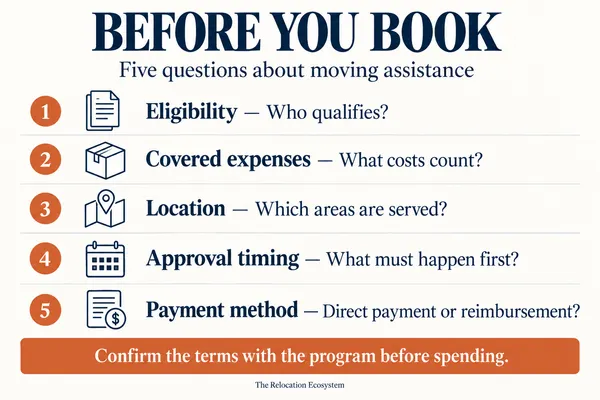
For an employer-sponsored relocation, the benefits being offered matter too.
A destination may ultimately be financially attractive while still requiring significant upfront cash to reach it.
Standard of living matters more than a ranking
The objective is not necessarily to find the cheapest city.
It is to determine whether moving allows you to maintain or improve the life you value at a sustainable cost.
That is a very different calculation.
Two households earning exactly the same income can reach very different conclusions about the same destination because their housing needs, family structures, careers, transportation requirements and priorities are different.
This is why we view broad rankings as evidence inputs rather than answers.
They tell you where to investigate.
Your circumstances tell you what the information means.
Compare destinations around your life
Before deciding that a city is a great—or terrible—place to relocate, build the comparison around your actual household.
Compare your current location with the potential destination using your real expected income, housing situation, insurance costs, taxes, commute, schools or childcare, healthcare needs, transportation, support network and estimated cost of making the move.
Then ask the final question:
After everything changes, are we actually better off?
Sometimes the answer will be financial.
Sometimes it will be about opportunity.
Sometimes it will be about family, time, lifestyle or quality of life.
Usually, it will be some combination of all of them.
And that is why the best place to move cannot be determined by a ranking alone.
The Relocation Ecosystem perspective
City-level data → Affordability → Quality of Life → Household Circumstances → Career & Economic Fit → Relocation Cost → Personal Priorities → Destination Fit → Decision
The goal isn’t to tell everyone where they should live.
It’s to help people make a better-informed decision about where their life can work best.
Source note: This article was prompted in part by Visual Capitalist’s September 9, 2026 analysis, Ranked: 100 Global Cities by Quality of Life and Cost, based on Numbeo data. Numbeo notes that its indices incorporate both collected data and user-contributed survey information, so city-level comparisons should be treated as comparative indicators rather than individualized financial or relocation advice.


Add your perspective
What does your experience add?
Which part of this guidance matches your experience—and which needs a different perspective?
Share one example, your role and any supporting evidence. Disagreement is welcome when it helps clarify the decision.